
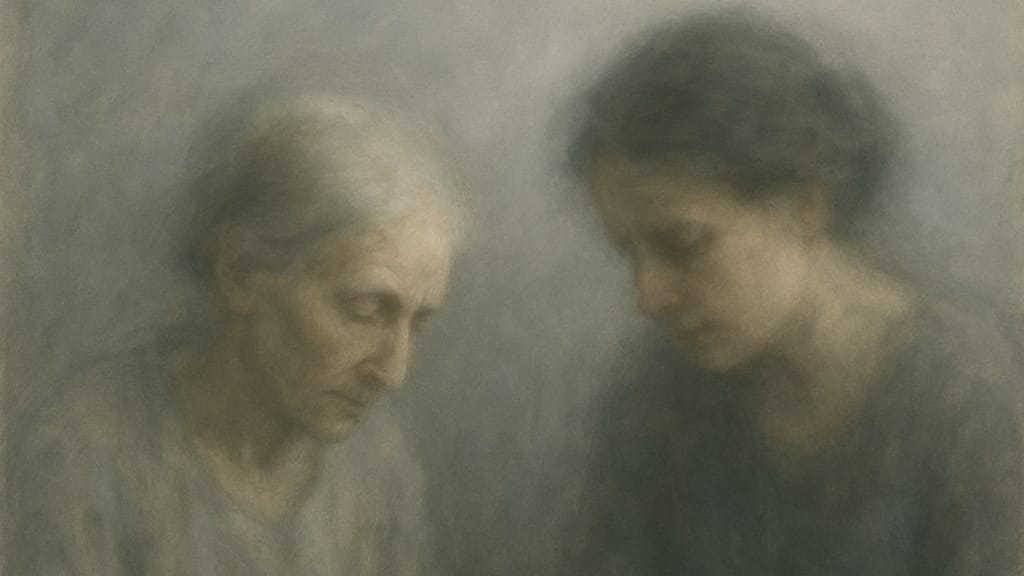
I just lost my temper with my Mum, my tiny – now child-sized – 80-year-old, crippled Mum.
She didn’t cry, but wasn’t far off it, and neither was I. In full flight mode, I stormed out from her little flat, down the stairs, out of the block and took the first few steps towards my car before other thoughts and feelings kicked-in enough for me to stop, sigh, turn around and go back in. She answered the door to me, and I gave her a hug, trying to simultaneously apologise and explain how incredibly frustrating – infuriating – our interactions with her were now. Before I’d even finished, she was already defensively insisting that she was doing the things we’d just argued about her not doing, probably having already forgotten what I was saying to her just moments ago, or certainly not having been able to process them.
Mum has dementia. It’s undiagnosed, and will likely remain that way for a while yet despite my efforts time and time and time again to get her the help and assessments she needs. She’s been cognitively declining for years, but it’s been particularly evident this last year as her physical condition has deteriorated dramatically too. The two are undoubtedly connected, but I don’t seem to be able to get the health and social services to recognise this, to see her as a whole. But we are, finally, on a waiting list for more thorough assessment through the Memory Assessment Service, a wait of about 10 months they reckon.
Meanwhile, despite not having consent to discuss Mum’s needs with her GP surgery or with Adult Social Care, despite the unintentional gas-lighting – is there such a thing? – by the services and by Mum herself, despite the absolute lack of meaningful support for either her or us, I try to remember that none of this is anyone’s fault, that Mum can’t help the way she is, and I try to remain kind and patient.
Sometimes that comes easily. During the many, many conversations I’ve had about Mum with friends, the rotation of care assessors, health and social care professionals, and most especially with myself, I’ve wondered why I get so upset, really, really upset. Why can’t I handle this? Why does this exhaust me so? Ok, I didn’t ask to be her carer or advocate, but I’m her daughter, her only remaining child, the only person who really can be those things in the absence of any other close family or friends, and seemingly all I have to do is put my own boundaries in place and diarise stuff related to Mum. I can sort her prescriptions out proactively. I can do a regular shop with her or for her, sort of. I can text or WhatsApp her multiple times every day to remind her of what meds to take and when and try to work out what she’s actually taken and when and follow that up at set intervals. I can, I must, be kind and patient when she repeatedly fills the silence that I desperately need whilst driving her to the doctors or hospital or shops again with exactly the same thing that she said 2 minutes ago, 10 minutes ago, last time, every time.
Sometimes, more often than I care to admit to myself, a rage bubbles up inside me when I’m dealing with Mum. That’s how I term our interactions now, me “dealing with” her. Sometimes the bubble is slow and gives me warning, so I notice it and can take steps to avoid it developing further, usually removing myself (and often my children) from the situation we’re in. Other times, like today, it appears from nowhere and bang! I know she’s still my Mum; she still loves me and in her own mind would fight whatever fight was needed to help me in times of need, but in reality, she’s not capable of anything like that now. The urge to be my mother is still there, but the skills have gone, and she has no idea. It’s often said that dementia is like a slow death, with a little part of that person dying every day. I’ve seen it in others. I see it with my Mum. In many ways, she’s already gone, and we’re left with this little old lady who has no idea how much has changed around her, how much the people around her have changed how they are with her. (People do it automatically, maybe it’s a good part of the human condition that we adapt how we talk and behave even with strangers.) But I’d say it’s not just a little bit of her that’s dying every day; it’s a little bit of our relationship, and a little bit of me, too, if I’m not careful. I don’t like the person I’ve become with her, and for her, and the effect being with her has on my days and my other relationships. It’s like a slow-acting toxin.
At risk of sounding callous, harsh, and downright horrible, the woman we have in our lives now is, quite frankly, stupid. I admitted this feeling, in confidence, in a mental health discussion a little while ago; it’s not a view I’m proud of as I don’t think it’s acceptable to call anybody ‘stupid’. And yet here we are, me thinking it and now saying it publicly. During that mental health consult, which was about my own plummeting mental health, I was trying to describe my Mum’s decline as succinctly as possible, and that was the word that wanted to come out. I apologised in advance for saying it, for even thinking it, but said, “it’s like she’s just become stupid”. But I also reasoned that if I were to believe the official line that my poor mother “has capacity” and doesn’t have dementia, as she has no formal diagnosis, then what’s going on? All we’re left with is a seemingly cruel, manipulative, yet incredibly stupid person. That in itself doesn’t sit right as my understanding is that truly manipulative people must possess a certain kind of intelligence, and I’m as sure as I can be that the behaviours my Mum exhibits can’t be put on. They can’t have it both ways: either she has some sort of dementia, or she has something else wrong in her brain that equally needs urgent investigation: an increasing personality disorder combined with a decreasing intellectual ability. The doctor I admitted these feelings to, thankfully, acknowledged and agreed that that’s exactly what dementia is, confirming my hypothesis but also reassuring me that it was ok to feel the frustration of it all. I don’t think I’ve ever felt so relieved after expressing my own conflicted feelings, and I believed him when he reassured me at the time that ‘the system’ would pick-up on it all soon and I could step back. Spoiler, it didn’t, and I haven’t.
This dark side of my feelings towards the little old lady who used to be my mother, who is still my Mum but twisted and crippled not just through her spine but throughout her very being, disturbs me greatly. I have a constant struggle with myself whenever I’m thinking about her in any way, with the feelings of dread and burden piling ever higher, as to why I can’t just keep hold of the kindness and patience. Getting cross with her doesn’t serve either of us, and it certainly doesn’t change anything as even any seemingly pivotal conversation is forgotten, lost to her. We could have the same conversation again later, and tomorrow, and every hour of every day, never being able to learn from it or move on. Groundhog Day on steroids. That’s maybe the hardest thing, not just the forgetting per se, but seeing the inability to learn, to process, the unlearning. It’s the whole array of executive functions that are destroyed, including working memory, comprehension, and insight.
How can you have a relationship with someone who doesn’t know what’s going on with you anymore, who seems not to care about the important things in your life because they can’t grasp hold of them, either through failed memory recall or faulty storage? How can I love my mother, or my children love their grandmother, when she has no real idea who we are? I don’t mean in terms of names or relationships – thankfully she does still know who we are in that sense – but in terms of what we do, what our lives look like, our struggles and our passions? It’s like talking to someone we knew a long time ago but no longer have a connection with; repetitive small talk only, or repeated instructions. There might occasionally be more meaningful stuff but said in the way we might talk to a stranger on a train, heartfelt and understood on some level, but ultimately lost to that moment in time. We remember it, but that person we were talking to no longer exists in our lives.
I’ve been surprised, too, at how incredibly stressful I find the immense repetition. That part at least should be simple to deal with, right? We just have to engage a certain mindset, or maybe it’s more accurately putting on another mask. My Mum is – always has been – incredibly judgemental – undoubtedly unconsciously so – and we’ve never had the best mother-daughter relationship. To have all her negative traits now exaggerated and put on repeat play every couple of minutes is mentally exhausting. And yes, I know she can’t help it. I know, or at least hope, she doesn’t mean to continually drive us closer to insanity on all fronts. Kindness and patience, I know. But I too have my own issues, as do we all, and for my own protection I wouldn’t choose to spend time with someone with such negative traits, who is incapable of meaningful conversation or the ability to help themselves and stop causing me stress. Yet I’m socially, morally, and emotionally obliged to spend time with this one, and I am aware too of my growing resentment. “It’s not her fault,” I continually remind myself, “it’s the disease”. Yet on top of that I have her and all the professionals telling me she’s fine, she has capacity, there are no concerns. So she’s like this on purpose then? She, in turn, when they do tentatively try to help, tells them it’s me, that I’m meddling, that I want to get her diagnosed with dementia for God knows what reason (other than the fact the diagnosis will hopefully open doors to recognition and appropriate support, possibly even medication if it’s not too late, though I don’t know how it would be administered when she can’t even understand or remember to take her current meds despite being constantly reminded of her ailments). This paranoia that I’m trying to get her locked away in a care home somewhere – delusions and false beliefs, too, are documented symptoms of dementia – have to be believed as there’s no diagnosis, and have meant that my efforts to get her help have been thwarted at every turn. She tells them she’s fine, I’m the problem, and they go away.
I got to the stage recently where I received a phone call from someone at Adult Social Care telling me to back off, to stop emailing and calling in, when they “have no concerns”. As well as dealing with the day-to-day stuff with and around Mum, and The System, and my own perilously poor mental health as a result (all whilst facing homelessness for a couple of months earlier this year), I was genuinely in fear of someone turning round and stating that I was making it all up, that I was the problem, that maybe I had Munchhausen’s by Proxy (now known, in the UK, as Fabricated or Induced Illness (FII) by Carers). I can’t over-state how worried I was about this, as I understood the safeguarding concerns the agencies rightly had for my Mum, but couldn’t see how else to make them see what was actually happening without repeatedly contacting the doctors or the Health and Social Care Connect service. And yes, I began to question my own judgement, not helped by a nurse who told me over the phone, after Mum had been unknowingly discharged following a night in hospital, that the woman I described was not the woman he had seen, and that she was just behaving that way with me, attention-seeking. For a moment, I believed him; what he said rang true with so many of the nagging doubts I’d had. But then I knew he was wrong, and had to find the courage to keep pushing, to keep fighting for a woman who still has no idea that there’s a problem – denial and lack of insight are also well-documented symptoms – begging for help from a system that’s so under-resourced that even the official advice now is that they wait until ‘failure’, wait until something goes terribly wrong. Things have gone wrong, and this is wrong, letting a woman who is able to manage through sheer ignorance and stubbornness live out what might be another 20 years of her life in constant pain, never being able to take her health into her own hands because that’s beyond her capacity, alienating her remaining family for reasons she can’t comprehend and not being able to do anything about it, spiralling into a smaller and more confusing world of loneliness and pain. Yes, let’s wait until something goes terribly wrong, and she’s no longer able to maintain any independence at all. Let’s kick the costs of some proactive care and support now further down the road until they become the bigger, unavoidable costs of residential care or hospitalisation. Yes, that makes sense. Except it doesn’t, and in the meantime, it’s not just one person who’s suffering; it’s everyone involved with that person. Maybe the hope is that that person will die, which some undoubtedly do, before they must intervene, and that the surrounding family will have access to private therapists to help them work through some of the trauma and guilt.
Sometimes, like in writing this now, I get fired up at the injustice of it all – not just dementia itself which is truly one of the cruelest conditions of the human experience – but of the very broken health and care system which, behind it’s published rhetoric of ‘early diagnosis being important’ and ‘support for family carers being important’ too, is shockingly, woefully, dangerously inadequate and inept. Dementia is a tricky thing, and no, I don’t know what all the answers are, but I know that I’m not being listened to, and Mum isn’t getting the care or early treatment she should be getting. We’re losing her more and more each day, but not enough, yet, it seems, or in the right ways, for the services to step in. I’ve lost something of myself this year, too, as I re-entered a depression of a depth I’ve not experienced for a long, long time and was teetering on the edge of being suicidal for longer than any carer, any person, should ever have to endure. I literally begged the services for help, and they failed us, repeatedly, and in fact made things worse.
Luckily, I’ve been able to bounce around at the bottom of that pit, sometimes bouncing up a bit higher and starting to see the light again. I can see that whilst yes, I absolutely, unequivocally, do fuck-up and do get things wrong, that I do somehow keep pulling some strength, some patience, and some kindness out of somewhere unseen and keep going. I don’t know if it’ll always be that way. I don’t know how many times I’ll reach the point of rupture before I stop being able to repair, either in my relationship with my Mum, with myself, or with others, but for now, we just keep on keeping on. Kindness and patience apply to ourselves, too. Kindness and patience.
I hear you 🫂
Thank you 🤗
Always here if you need to vent or a hug x
Thank you!
Thank you for sharing your very honest thoughts and feelings on your experience having your mum live with dementia. I can’t imagine how frustrating it must be not to get the early support for your mum, especially as the emphasis is always on diagnosing early on to receive the support is so important. I really hope you get the support you, your mum and family so deserve.
Thank you for your words of support 🙏 A tragic part of this journey is realising that we’re just one family, and knowing there are countless other people out there suffering, many of whom won’t have anyone to advocate for them. It’s so important we get these services working as they should.