
Since moving house a few weeks ago, one thing amidst the chaos that has become a constant is waking up every morning feeling like I can’t quite breathe properly. It’s not a desperate gasping for breath, or anything particularly noticeable to the outside world, but it’s the first, all-consuming thing that floods my awakening consciousness. It’s that feeling you get when maybe just getting or just recovering from a chesty cold: slightly but not completely congested; feeling like you’ve probably been breathing through your mouth; and a vague sense of heaviness on the lungs.
I’m asthmatic, allegedly, and have been probably all my life but diagnosed as such just a few years ago. I say “allegedly” as asthma is one of those conditions that is often diagnosed by process of elimination: other conditions are ruled out through various tests following a particularly symptomatic time, and if what you’re left with fits a general asthmatic profile, then that’s your answer. I don’t mean to sound quite so scornful of it, it’s just that asthma is still really such a very vague and poorly understood condition in many respects. Things we thought we knew about asthma, it seems, are in fact not quite so and much research is still needed. Yet here we are.
I was diagnosed whilst heavily pregnant with my youngest, and last, child, at the grand old age of 41. I’d often wondered if I might be asthmatic or have some other underlying issue, but would then almost immediately dismiss the thought as being overly-dramatic. I had never had what I had thought of as an actual asthma attack, or been ‘wheezy’. Of course, with a chesty cough or chest infection I would get very rattly and crackly, but doesn’t everyone? Indeed, I’d seen my son go through his own asthma diagnosis and occasional bad period as a child and adolescent, and an ex-partner absent-mindedly puff away on his blue inhaler, incorrectly, I quickly realised, and didn’t particularly recognise my symptoms in theirs. But, the consultant I saw at the hospital – a kindly, very respectable, older gentleman – was thorough in the tests he requested upon my urgent referral back in 2015. I’d been noticing how short of breath I was getting when having to talk at length at work, and then had a couple of incidents – one at work and another at the gym – where I felt like I just could not breathe and was going to pass out. I guess they were asthma attacks, but not like anything I’d ever seen before. Nonetheless, as I was in very early pregnancy by then – about 5 weeks I seem to recall -when sent up to the hospital by a GP – and as I’d previously had a cancer, I was taken seriously, and after a blood clot and lung cancer were ruled out that very day, a series of lung function tests and period of recording peak-flow data commenced. It was some time later, at about 7 months pregnant, that I finally saw the lovely consultant again and he said I was most likely asthmatic, and set me up with a plan to manage it.
Anyway, back to me lying in bed, half awake and very much aware that I’m not feeling quite right, again. And, just as importantly, being very much aware of the again part of that, that this was not an isolated “maybe I’ve got a bit of a cold coming on” moment, but a regular feature of life in our new house. Every morning, waking feeling not fully-rested – ok, not that unusual in itself – but aware that at least part of that may, just may, be due to not having breathed very efficiently during the night, and that I should now really do something about that.
Fortunately I didn’t feel an urgent need to jump out of bed and get started on things today, and so instead, threw on my dressing gown and slippers – it’s cold in our new house with uncarpetted flooring in most areas, making slippers a reluctant but necessary addition to my life – and went in search of my peak-flow meter. For those not in the know, this is not anything as grand as it sounds, and is a simple plastic tube with a sliding bit on it that moves along a measurer upon blowing into the mouthpiece. It’s what we asthmatics use to record our lung capacities in times of doubt, or when requested to monitor by our healthcare professional. I’m sure most of us don’t really keep tabs when we’re feeling fine, but it is useful to record the measurements over a week or two if we feel we’re starting to struggle. I never go to a doctor with a suspected chest infection these days without having compiled a list of measurements, as evidence, to help and speed-up their assessment. It’s all part of the joyous asthma management plan. (Just to add, that’s not to say help shouldn’t be sought in the event of sudden or severe breathing difficulties, asthma diagnosis or not!) Now, I need to add, this move has been a very prolonged event involving both my partner and I gradually moving stuff upon stuff into the new house, at first in a very orderly fashion and latterly, as time pressures really kicked in, much less so. Needless to say, my peak-flow meter wasn’t where I thought it was, and after a couple of cursory looks in a couple of places, I gave up the search and resolved instead to get more things tidied and put away throughout the course of the day.
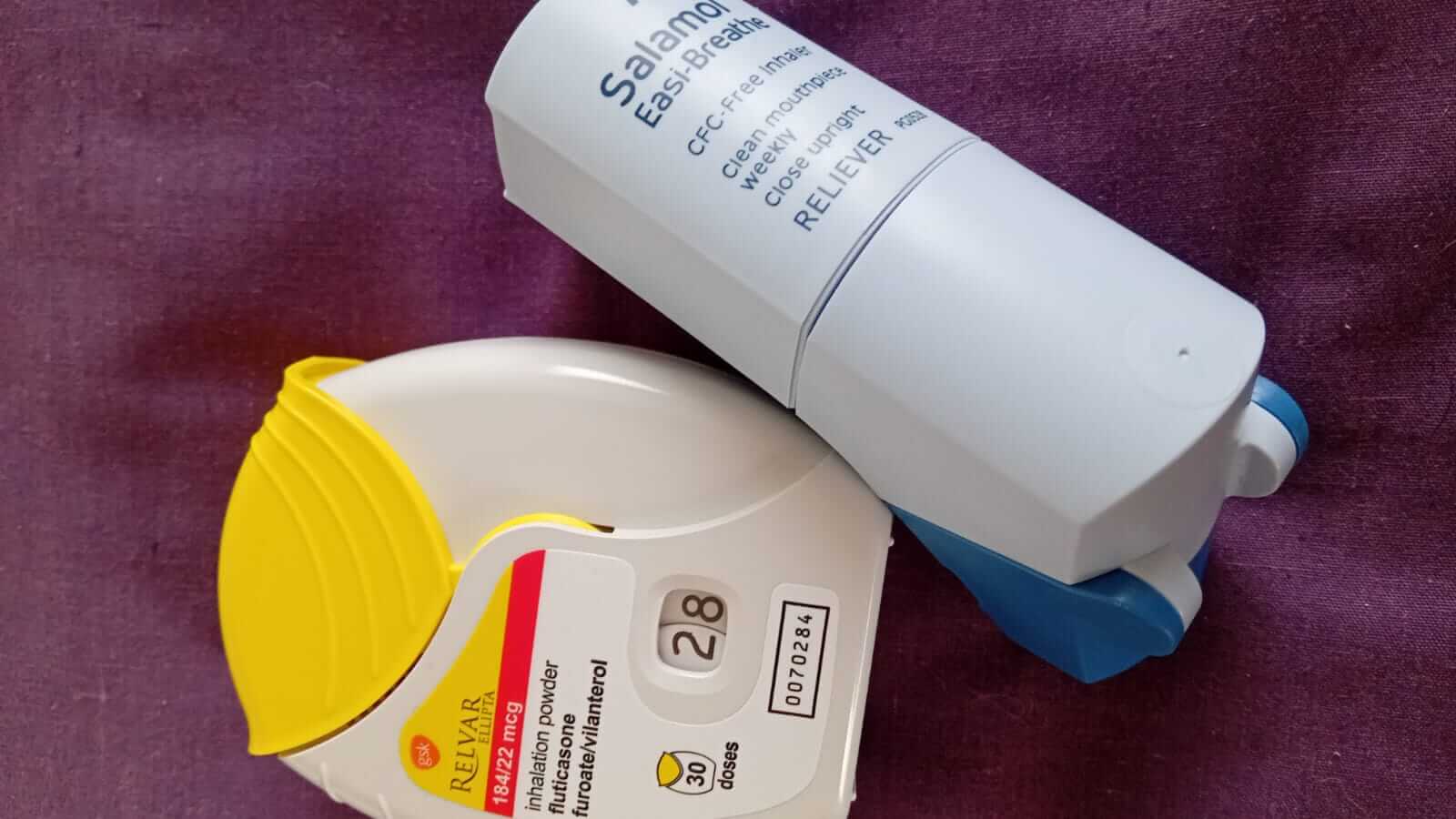
Fast forward a few hours and I’m sitting down again, this time fully-dressed at the table rather that dressing-gown clad in my bed, tapping away on my laptop but aware oh-so-acutely how heavy my lungs feel. I’ve just had a blast on my blue (reliever) inhaler, something that was always a rare event for me but has started to become increasingly frequent. That, in fact, perhaps more that anything else is one of the reasons I still say “allegedly” asthmatic, as I never really feel I’m getting any benefit from my inhalers, despite using them properly, and having had different ones and different formats over the years. The relievers are typically stimulants, designed to open the airways, but in doing so make my heart race uncomfortably and at times have made me feel really quite unwell, resulting in me generally preferring to try to breathe my way through any difficulties with slow, deliberate, controlled breaths than use my inhaler. But, for whatever reason, I’ve not felt the ill-effects with a puff recently and so am giving it another chance. In all honesty, I still don’t feel it helps, but perhaps it stops things from getting worse – another thing to discuss when I next have an asthma review, again. I do still feel the controlled breathing and getting outside are probably my best self-treatments, but again, appreciate this may not be the case for everyone.
And so I return to the two-fold instruction to “just breathe”. It’s something we tell ourselves and each other when panicked, or in pain, or as a gentle instruction during meditation or yoga. Such a very simple thing, yet something that seems increasingly problematic when we realise we’re not doing it quite as automatically or quite as satisfactorily as we would expect. It’s the very thing we say when it’s the very thing we cannot seem to do. In most instances, it’s not about the ability to breathe at all but about the secondary effect that controlling our breathing has on our nervous systems; it’s about overriding and regaining control in those times of anxiety or discomfort. Conversely, when we can’t get the breathing bit quite right, we begin to feel that angst start to creep in, making it all-the-more important to just keep calm and carry on, to just breathe.
How bizarre that such a very natural, autonomic, generally unnoticed aspect of our very living becomes such a complex balancing act of physical and mental control, largely within the space of a very few seconds, as thought processes tend to be. And how unnerving not to be able to share or express these sensations to others around us, to share, even with people who know, that momentary sense of uncertainty as to whether we are going to be ok or need help. I, for one, certainly had no idea how it really felt to not be able to get that fully-oxygenated feeling, or how incredibly difficult it would be for me to try to convey it to others. I’m still not entirely sure that I have ever managed it, and I suppose that’s another reason why I still feel uncertain about my own asthma diagnosis, as I can never be fully sure that what I feel is what other asthmatics feel.
For today, I shall seek out that peak-flow meter again and if unfound, shall find a pharmacy that sells them and get a new one. Today it feels important that I have one and start monitoring myself again, for the reassurance that either yes, my lung capacity is slightly reduced, particularly in the mornings and thus I need to investigate the cause, or that no, all is well, and there is another explanation for my slightly constrained sensations. Throughout all of it, I must make sure to just breathe.